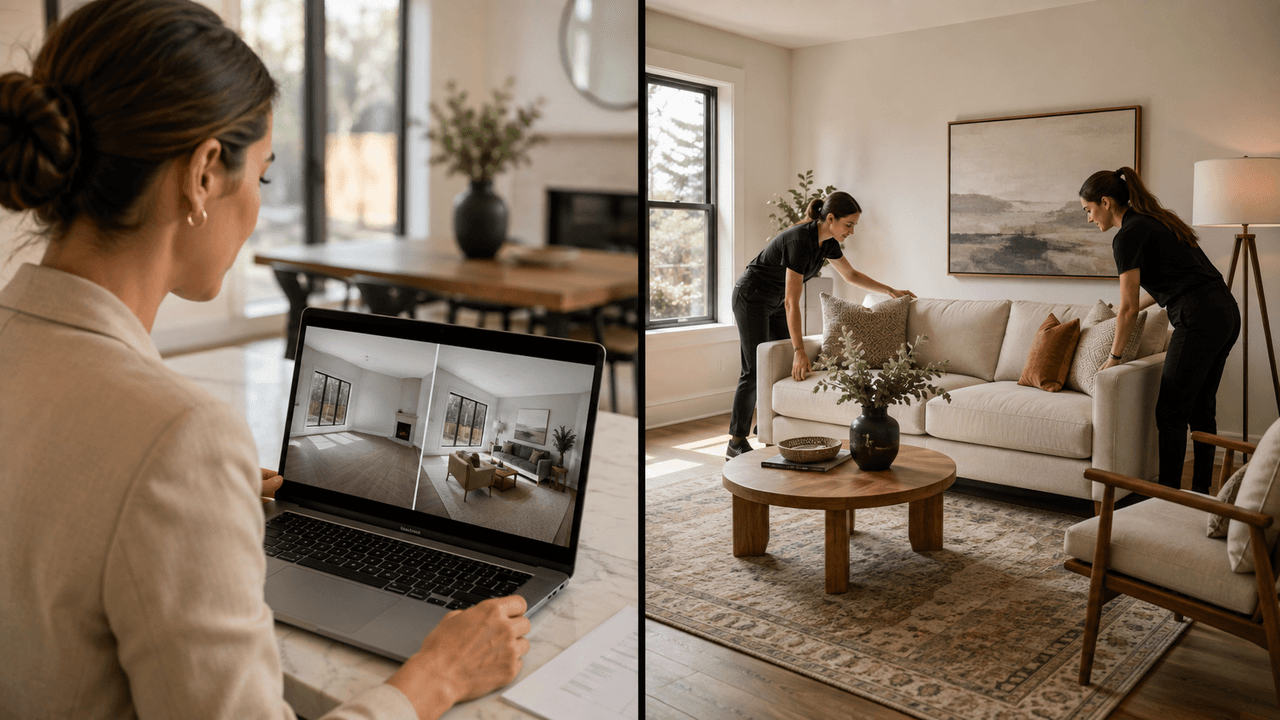

AI virtual staging and traditional staging solve different parts of the same problem. AI virtual staging adds digital furniture and décor to property photos, while traditional staging places physical furniture inside the home. Virtual staging is generally more flexible for listing images and vacant-property marketing. Traditional staging creates an in-person furnished experience for buyers visiting the property.
The right choice depends on the property, marketing plan, available time, budget, target buyer, and whether the main priority is online presentation or the physical showing experience.
This guide compares AI virtual staging vs. traditional staging so that real estate agents, property marketers, photographers, and sellers can choose the most appropriate approach.

What Is AI Virtual Staging?
AI virtual staging uses artificial intelligence to add digital furniture, artwork, rugs, lighting, plants, and other decorative elements to a photograph of a real room.
A typical workflow involves:
- Uploading a room photo
- Selecting the room type
- Choosing an interior style
- Generating a staged image
- Reviewing the result
- Exporting the approved image
The furniture shown in a virtually staged photo is not physically present in the property. The image is intended to help viewers understand how an empty or outdated room could look when furnished.
AI home staging is primarily a visual marketing and design tool. It does not replace property inspections, verified measurements, architectural plans, or an in-person viewing.
What Is Traditional Home Staging?
Traditional home staging uses real furniture and décor inside a property.
Depending on the condition of the home, the process may include:
- Removing personal items and clutter
- Rearranging existing furniture
- Renting furniture and accessories
- Adding artwork, rugs, lamps, and plants
- Improving the visual flow between rooms
- Preparing the property for photography and showings
Traditional staging may be completed by the seller, real estate agent, or a professional staging company.
Unlike virtual staging, physical staging affects both the listing photography and the buyer’s experience during an in-person visit.
Why Does Staging Matter?
Staging helps buyers interpret a property’s scale, function, and potential.
An empty room may be difficult to understand from a photograph. Without furniture, buyers may struggle to estimate whether the space can accommodate a sofa, dining table, bed, desk, or other familiar objects.
According to the National Association of REALTORS® 2025 Profile of Home Staging, 83% of buyers’ agents said staging made it easier for buyers to visualize a property as their future home.
The same report found that buyers’ agents considered the living room the most important room to stage, followed by the primary bedroom and kitchen.
These findings apply to staging generally. They do not prove that every staged property will sell faster or receive a higher offer. Pricing, location, condition, demand, photography, and marketing distribution continue to influence property performance.
AI Virtual Staging vs. Traditional Staging: Key Differences
Online Presentation
AI virtual staging is designed primarily for digital presentation.
It can turn an empty-room photograph into a furnished visual that is easier to understand in:
- Property listing pages
- Social media posts
- Digital advertisements
- Email marketing
- Property presentations
- Online brochures
Traditional staging also improves listing photography, but the furniture must first be delivered, arranged, and photographed inside the property.
If the main objective is to improve how an empty property appears online, virtual staging may offer the more direct workflow.
For teams using virtual staging for real estate marketing, this approach can simplify the preparation of listing visuals for vacant properties.
In-Person Experience
Traditional staging has a clear advantage during physical property visits.
Buyers can walk through the furnished rooms and experience:
- Furniture scale
- Walking space
- Room flow
- Seating arrangements
- The relationship between different areas
Virtually staged furniture exists only in the images. When buyers arrive at the property, the room may still be empty.
For this reason, sellers and agents should make sure prospective buyers understand that the furniture shown in virtually staged photos is not included in the property.
Preparation and Logistics
Physical staging can involve:
- Property access
- Furniture selection
- Delivery scheduling
- Installation
- Storage
- Insurance
- Maintenance
- Furniture removal
AI virtual staging does not require physical furniture delivery because the staging takes place inside the property images.
However, virtual staging still requires preparation. The original photographs need to be clear, correctly exposed, and taken from useful angles. Generated images also need to be reviewed for scale, perspective, architectural accuracy, and visual artifacts.
Virtual staging reduces physical logistics, but it does not eliminate quality control.
Cost Structure
Traditional staging costs vary according to the property size, number of rooms, location, rental period, furniture quality, delivery requirements, and staging provider.
In the NAR’s 2025 survey, sellers’ agents who used a staging service reported a median spend of $1,500. This is a survey result for staging services generally, not a fixed market price or a quotation for every property.
AI virtual staging usually follows a different cost structure because it is based on digital images rather than furniture rental and installation. Pricing may depend on:
- Number of images
- Subscription level
- Generation credits
- Image resolution
- Revision options
- Commercial usage requirements
When comparing virtual staging cost with traditional staging, compare the total project workflow—not just the advertised price of a single image or service.
Design Flexibility
AI virtual staging can make it easier to explore multiple design directions for the same room.
For example, an agent may want to compare:
- Modern
- Scandinavian
- Minimalist
- Contemporary
- Coastal
- Farmhouse
Creating multiple physical versions of the same room would require replacing or rearranging furniture. With virtual staging software, alternative visual concepts can be generated without physically changing the property.
However, having more options is not always better. Too many inconsistent styles can weaken the property’s visual identity. The selected design should match the property’s architecture, price range, location, and likely buyer profile.
Consistency Across Multiple Listings
Real estate professionals and photographers may need to prepare images for several properties or multiple rooms within the same property.
AI virtual staging can be useful when the goal is to:
- Stage several vacant units
- Create a consistent visual direction
- Test different room functions
- Prepare listing imagery without coordinating furniture delivery
- Manage repeat visual-staging work
Traditional staging may be more appropriate for a smaller number of high-priority properties where the physical buyer experience is central to the sales strategy.
Accuracy and Buyer Expectations
Traditional staging uses real furniture in the real space, so the physical relationship between the furniture and the room can be observed directly.
AI virtual staging estimates furniture placement from a photograph. A single image may not provide complete information about exact room dimensions, ceiling height, or hidden areas.
Virtually staged photos should therefore be checked for:
- Unrealistic furniture scale
- Blocked doors or walkways
- Altered windows
- Changed wall positions
- Modified flooring
- Incorrect lighting or shadows
- Objects overlapping walls
- Missing permanent features
- Unrealistic exterior views
The objective is to present the room’s potential while keeping the image faithful to the real property.


When Should You Choose AI Virtual Staging?
AI virtual staging may be appropriate when:
- The property is empty or sparsely furnished
- The main priority is online listing presentation
- Furniture delivery is impractical
- Several rooms or units need visual staging
- The property is not easily accessible
- Multiple interior styles need to be explored
- The seller wants to retain an empty property for showings
- A photographer wants to offer staged listing images
- The marketing team needs a repeatable visual workflow
It can also be useful during the early marketing stage, before a decision is made about physical staging.
AI virtual staging is less suitable when the buyer’s in-person experience depends heavily on seeing and moving through furnished rooms.
When Should You Choose Traditional Staging?
Traditional staging may be more appropriate when:
- The property will receive frequent in-person visits
- Buyers need help understanding the physical flow of the home
- The property is positioned as a high-touch or premium listing
- The empty rooms feel cold or difficult to interpret during viewings
- The seller wants the photography and physical property to match
- Existing furniture can be rearranged effectively
- A professional stager’s on-site judgment is important
- The budget and timeline allow for furniture installation
Physical staging may also be preferable when a room has an unusual layout that cannot be understood accurately from photographs alone.
Can You Use Both?
Yes. A hybrid strategy may be the most practical choice for some properties.
For example, a seller or agent could:
- Physically stage the living room and primary bedroom
- Use AI virtual staging for secondary bedrooms or a home office
- Use virtual staging during early marketing
- Add physical staging later if buyer feedback shows it is needed
- Use generated concepts to help plan physical furniture selection
The NAR’s 2025 report found that the living room was the most commonly staged room among surveyed sellers’ agents. This supports prioritizing the rooms that have the strongest influence on how buyers understand the home instead of automatically staging every space.
A hybrid approach should still remain visually consistent. The digital and physical design styles should not make the same property appear like two unrelated homes.
How Should Virtually Staged Photos Be Disclosed?
Virtual staging disclosure is an important part of responsible real estate marketing.
The NAR Consumer Guide to Home Staging notes that photo enhancements materially altering a property should be disclosed so buyers receive a truthful picture of the home.
Specific requirements can vary by MLS, brokerage, advertising platform, and location. A practical workflow includes:
- Keep the original property image.
- Clearly label the generated image as “Virtually Staged.”
- Show the original and edited versions together where appropriate.
- Do not remove damage or conceal material defects.
- Do not change permanent architectural features.
- Confirm applicable requirements with the relevant MLS, brokerage, platform, or legal adviser.
VIRTUALLY STAGED
Furniture and décor are digitally generated.

A Practical Decision Checklist
Before choosing between virtual staging vs. traditional staging, answer the following questions.
What Is the Main Goal?
If the goal is online listing presentation, AI virtual staging may be sufficient. If the goal is to improve in-person showings, traditional staging may be more relevant.
How Many Rooms Need Staging?
Virtual staging may be easier to scale across multiple listing images. Physical staging may be reserved for the rooms buyers are most likely to prioritize.
Will Buyers Visit the Property in Person?
If they will, consider whether arriving at an empty property after seeing furnished listing photos could affect their expectations.
Does the Room Have an Unusual Layout?
Physical staging can help buyers experience difficult layouts. Virtual staging can still be useful, but the output should be reviewed particularly carefully.
How Quickly Could the Listing Change?
If the property is likely to sell, rent, or change availability quickly, evaluate whether a physical furniture rental and installation process is proportionate to the campaign.
Are the Disclosure Requirements Clear?
Before publishing virtually staged photos, confirm how the relevant MLS, brokerage, and advertising platforms expect the images to be labelled.
Where Astage AI Fits
Astage AI is relevant when the primary goal is to visualize an empty or outdated room in a furnished style without physically installing furniture.
It may be suitable for:
- Real estate agents preparing listing visuals
- Property photographers offering virtual staging
- Sellers marketing vacant homes
- Property teams comparing different design directions
- Homeowners exploring how a room could look when furnished
You can review transformations in the Astage AI portfolio and explore an interactive before-and-after comparison.
Astage AI is not a replacement for physical furniture during property visits, professional measurements, property inspections, architectural documentation, or legal disclosure advice.
Frequently Asked Questions
Is Virtual Staging Better Than Traditional Staging?
Neither method is universally better. Virtual staging is often more practical for digital listing images, while traditional staging provides a furnished experience inside the property. The right choice depends on the campaign objective.
Is AI Virtual Staging Suitable for Luxury Property Listings?
It can be used for luxury property marketing if the image quality, furniture selection, architectural accuracy, and disclosure meet the required standard. Some luxury listings may still benefit from physical staging because the in-person experience is especially important.
Can Virtual Staging Replace Physical Staging?
It can replace physical staging for some digital marketing needs, but it cannot create a furnished in-person environment. Buyers visiting the property will not see the generated furniture.
Is AI Virtual Staging Cheaper Than Traditional Staging?
The two approaches have different cost structures. Virtual staging does not require physical furniture rental or installation, but actual costs depend on the software, image volume, editing requirements, and service model.
Do Virtually Staged Photos Need to Be Labelled?
Requirements vary, but clearly labelling generated images is a responsible practice. Always check the rules that apply to the property, listing platform, brokerage, and location.
Final Thoughts
The decision between AI virtual staging vs. traditional staging should begin with the marketing objective.
Choose AI virtual staging when the priority is flexible, scalable visual content for listing images. Choose traditional staging when the property needs to deliver a furnished experience during in-person visits. Consider a hybrid approach when only the most important rooms require physical furniture.
Whichever method you choose, the presentation should remain accurate, visually consistent, and appropriate for the property.
To explore AI-assisted staging in practice, visit Astage AI and review its before-and-after transformations.